The Genkan Remembers Your Day
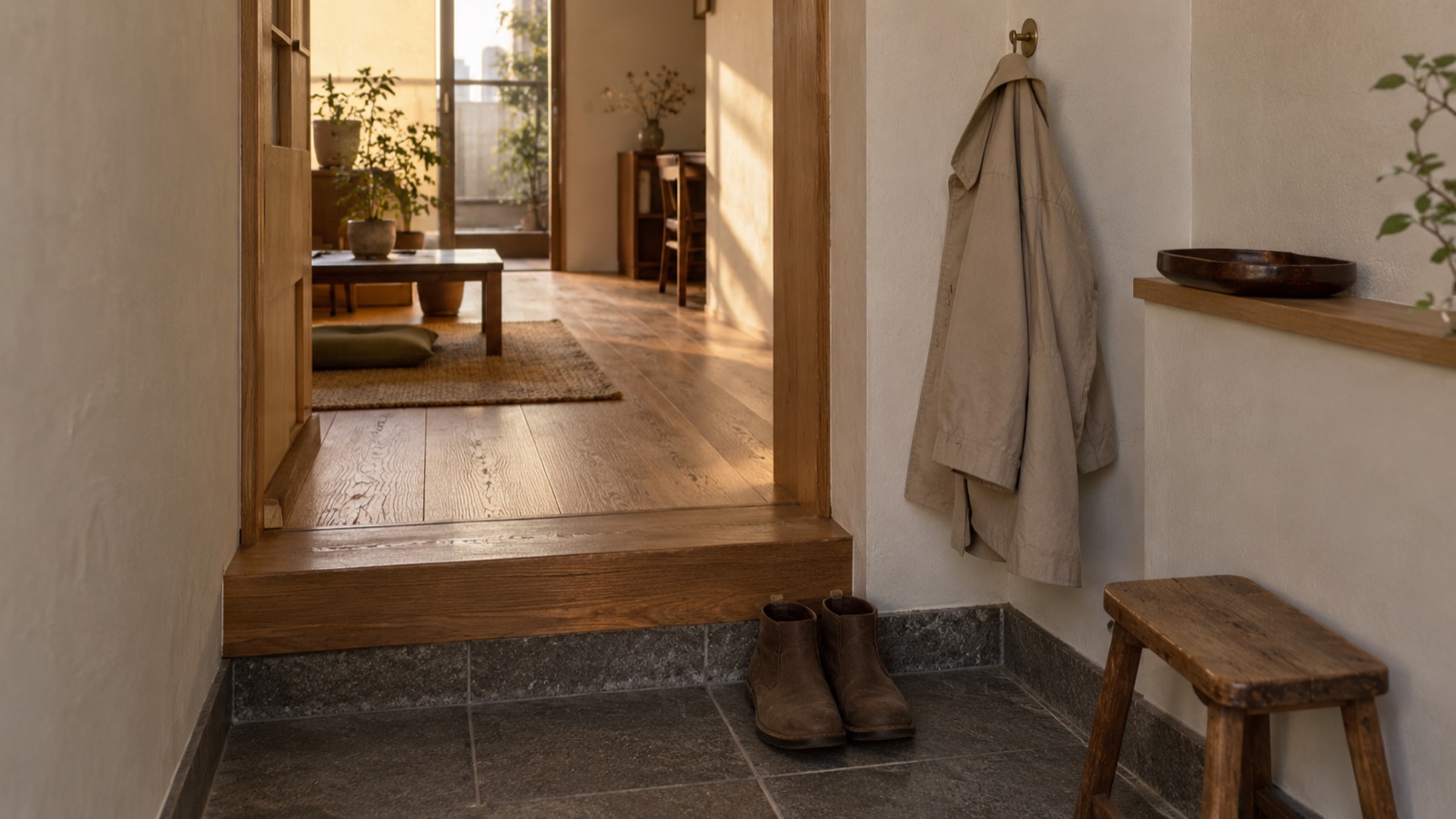
My genkan is ninety centimetres deep. That is not a boast; it is a confession. When I moved in I wanted a proper one, the kind my grandmother had in Kyoto, where you could sit down on the step and take your time. I got a strip of tile the width of a bathmat, and a coat hook that came with the flat.
So I made a rule. The genkan is not storage. It is the room where the day ends. Everything I put there has to earn the space by doing one honest job.
There is a low stool, cedar, twenty-eight centimetres tall, made by a man in Toyama who also makes butter knives. I sit on it to unlace boots. Standing on one leg at forty-two is a young person's game, and I am not interested in playing it in the dark at eleven at night.
There is a shallow lacquer tray, the colour of wet bark, for keys and the small change that accumulates in a coat pocket like weather. When the tray is full on a Sunday I know the week was long. When it is empty I know I stayed home, and that is information too.
There is one hook, not four. Four hooks become a wardrobe. One hook holds today's coat, and yesterday's coat has already been put away, because the rule of the hook is that the hook is for now. This is the whole discipline of a small flat: decide what now means, and give it a place.
The floor is oak, unfinished, oiled once a year with a rag and something that smells like a forest in July. It marks. I like that it marks. A house that refuses to show it has been lived in is a house that is embarrassed by its owner, and I will not live somewhere that is embarrassed by me.
People ask what to put in a genkan and I always want to ask them the other question first: what do you want to feel in the four seconds between closing the door and taking off your shoes. Relief. Quiet. The small pride of a place that was waiting for you. Everything in the ninety centimetres has to serve that, or it has to go.
Tonight the tray has two coins and a receipt from the bakery on the corner. The stool is where I left it. The coat on the hook is still cold from the street. I sit down, I untie the left boot, then the right, and the day, which was not a good one, agrees to be over.
Mio Tachibana was born in Kyoto, trained as an architect and left the drawing board to write about the rooms people actually live in. She keeps a 48-square-metre flat in Tokyo with one good chair and too many bowls, and believes a room is a decision about how you want to be tired at the end of the day.